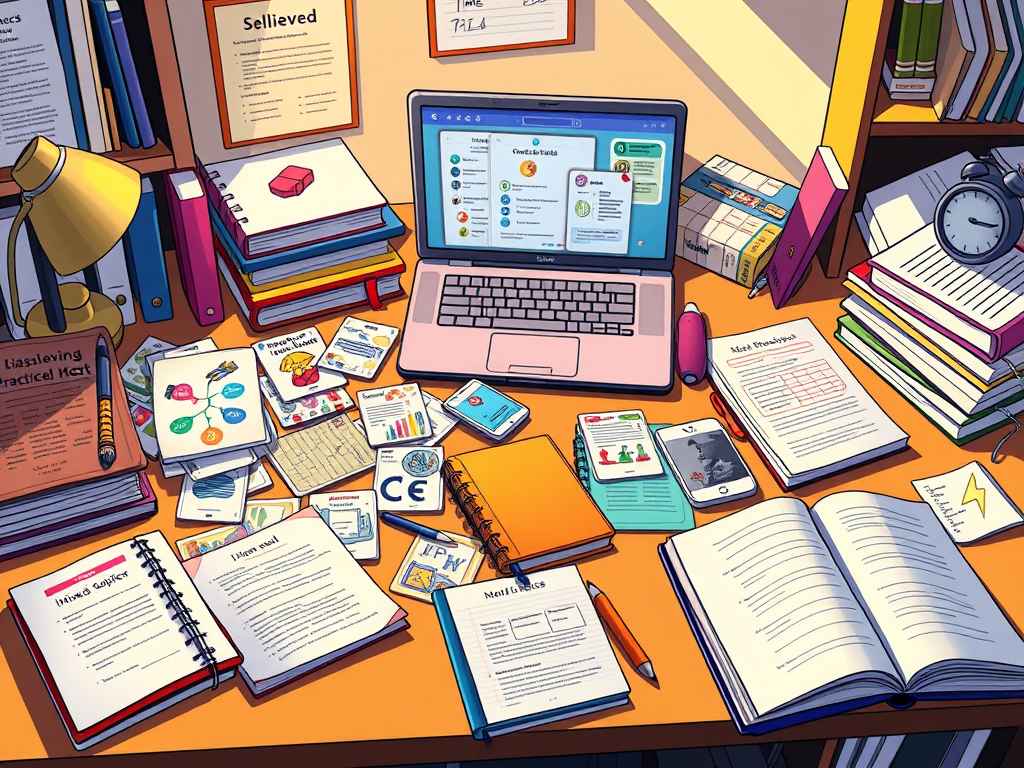
The brain craves novelty, which can sometimes make repetitive tasks like reviewing previously learned material tedious. However, with some creativity, you can leverage the brain’s love for novelty to enhance your review process. Here are some strategies you can consider:
- Interleaved Practice: Instead of dedicating long periods to a single topic, shuffle or mix different topics. This approach has been shown to improve retention and is based on the principle of interleaved learning. This constant switching can make the material feel fresh and less repetitive.
- Teach Others: Find a study partner or a friend and teach them what you’ve learned. Explaining the content to someone else can reinforce your understanding and make the review process more engaging.
- Flashcards with a Twist: Use tools like Anki or Quizlet to create flashcards. But instead of just having a question on one side and an answer on the other, try to create flashcards in a novel way. For example, use pictures and mnemonics or create small stories around the concept.
- Contextual Learning: Try to put what you’ve learned into real-world context. For instance, write a short story using those words if you’ve learned new vocabulary. If it’s grammar, try to speak or write sentences that mainly focus on that grammar point in different contexts.
- Test Yourself: Create quizzes or tests for yourself. Challenge your brain by setting a time limit. This reviews the material and prepares you for real-world situations where you need to recall information quickly.
- Engage Multiple Senses: Use auditory, visual, and kinesthetic means to review. For example, read aloud, listen to content (like podcasts or videos), write or type notes, or use gestures and actions to describe certain concepts.
- Change of Scenery: Study in different locations. The change in environment can make the same content feel new and fresh. This is based on context-dependent memory, where information is better recalled if the surroundings match or are varied during learning and retrieval.
- Use Gamification: Turn your review into a game. Several apps and websites gamify learning. Alternatively, you can create your own games. For example, you could challenge yourself to recall as many words or concepts as possible in two minutes.
- Mind Maps and Infographics: Convert your notes into visual formats like mind maps or infographics. The process of creating these visual representations can serve as a form of review, and they also provide a novel way to look back at your notes.
- Re-structure Notes: Try to re-structure or re-format your notes after a while. Maybe make them more concise or expand upon specific points. This will force you to engage deeply with the material again.
Remember that consistency is critical. Even if you crave novelty, it’s essential to maintain a regular review schedule. Combining the above strategies can make the review process both engaging and effective.




 Notes
Notes 
Leave a comment